







How to Make More Money From Your Customers

Customers are often the fastest route to making more money because better retention, fewer repeat contacts and fewer refunds improve revenue and margin at the same time. Start by measuring churn, repeat contact and refunds, then give one senior person clear ownership of the customer function and its commercial results.
Where can a growing business make more money?
A growing business can often make more money from its existing customer base before it needs more leads or a larger sales team. Three leakage points deserve immediate attention:
- Churn: customers who leave reduce future revenue and increase the cost of replacement sales.
- Repeat contact: customers who need to ask the same question more than once consume avoidable service capacity.
- Refunds: refunds protect trust when necessary, but recurring causes can reveal broken products, processes or communication.
The commercial opportunity is to connect these measures. A customer issue that creates two extra contacts may also trigger a refund, damage loyalty and increase churn risk.
How do you calculate the money being lost?
Use simple sums before investing in a solution. For example:
- 100 avoidable refunds at £78 each represent £7,800 returned to customers.
- 500 avoidable contacts at £6 per contact represent £3,000 in service cost.
- Losing 20 customers worth £1,000 each in annual contribution represents £20,000 in missed value.
These are illustrations, not forecasts. Replace them with your own volumes and unit costs. The Cost per Contact resource can help you establish a more reliable baseline.
A useful starting dashboard should show monthly churn, repeat contact rate, refund value, complaint themes, customer lifetime value and cost per contact. Review the figures together rather than treating them as separate departmental measures.
Who should own customer profitability?
Give one senior person clear accountability for customer outcomes and their financial effect. This does not mean one person handles every issue. It means someone has the authority to connect service, operations, product, commercial and technology decisions.
That ownership matters because 38% of organisations have no senior owner for customer experience , according to our Retail Benchmark. Without accountability, teams may optimise individual targets while the business continues to lose value through preventable contacts, refunds or churn.
The right role could be a customer director, chief customer officer, customer operations leader or transformation executive. Define the mandate around measurable outcomes, such as:
- reducing avoidable contact;
- improving retention and customer lifetime value;
- lowering refund and complaint costs;
- improving trust, compliance and service consistency.
Explore Customer Leadership, Board Level if the issue requires a strategic leadership decision.
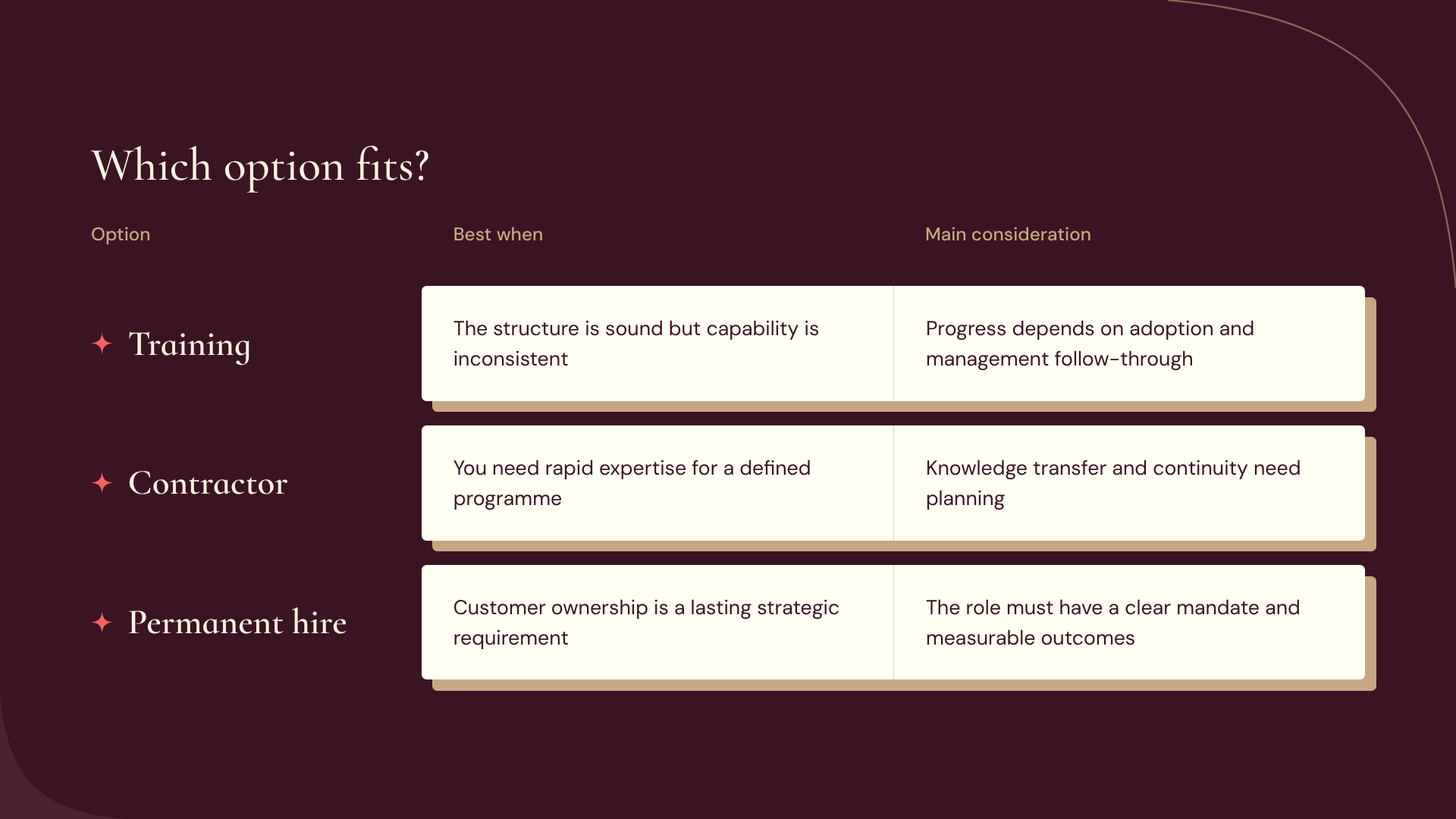
Should you choose training, a contractor or a permanent hire?
The best option depends on the gap, urgency and expected duration.
Training will not fix unclear accountability. A contractor may accelerate change but cannot replace a permanent operating model. A permanent hire is more likely to create lasting value when the business needs sustained leadership across Customer Operations , insight and service.

Before deciding, use a Skills Analysis to identify whether the problem is capability, structure, leadership or capacity.
Three actions to take next
- Measure the leakage: calculate churn, repeat contact and refund value for the last three to six months.
- Assign ownership: give one senior person responsibility for customer performance and commercial impact.
- Match the intervention: compare training, contractor and permanent options against the size and duration of the gap.
The takeaway
To make more money from customers, start by protecting the value you already have. Measure where churn, repeat contact and refunds are eroding revenue, then connect those numbers to a clear senior owner. The Retail Benchmark figures—78p refund value and 38% without a senior owner—show why this deserves leadership attention. Choose training, contractor support or a permanent hire based on the underlying need, not urgency alone. Apply the three actions above, then review the results regularly to confirm that better customer performance is improving both trust and profit.
Latest Posts
FAQs
Does bringing AI into a customer function mean replacing the leadership?
Usually not. It means checking that the leader can decide where AI helps and where it hurts, and lead the team through the change. Many can. Where they cannot, leaving it unaddressed is what costs you.
What should a board look for when hiring a customer leader for an AI-era function?
Lorem ipsum dolor sit amet, consectetur adipiscing elit, sed do eiusmod tempor incididunt ut labore et dolore magna aliqua.
Why does AI in customer contact carry more risk in regulated industries?
Lorem ipsum dolor sit amet, consectetur adipiscing elit, sed do eiusmod tempor incididunt ut labore et dolore magna aliqua.
How does Stellify approach these searches?
Lorem ipsum dolor sit amet, consectetur adipiscing elit, sed do eiusmod tempor incididunt ut labore et dolore magna aliqua.